Shally's Advanced LinkedIn Cheatsheet! I recommend this everywhere I go!
(disclosure: this cheatsheet costs $19.97, and I’m an affiliate)

LinkedIn Group Restrictions: Hand-slapping and Promises

August 7th, 2008

Earlier this week I saw a huge storm brewing about an e-mail that some LinkedIn users were getting from LinkedIn.  Basically, it said something like “you can only be in 50 Groups.  Trim it down asap, or we’ll do it for you.”

Their logic is summed up by Adam Nash, LinkedIn employee, on the GetSatisfaction complaint site:

“We’ve seen a tremendous boom in interest in LinkedIn groups this year, and we’re planning on launching some exciting new functionality to this area in the coming months. However, with the boom in excitement, we’ve also seen some abuse of the functionality.

The limit is an attempt to reign in potential abuse on the platform in the short term as we expand the functionality of groups. We’re definitely measuring and watching this area carefully, so we’ll expand this limit over time if technically possible.

Currently, there are a very small number of people outside of this limit, but we know that doesn’t help if you are one of them. We hope you and others will be patient as we work to make the groups platform on LinkedIn even more useful.”

They claim there aren’t many who this affects, and most are probably abusers anyway, so it’s not that big of a deal, right?  I’m only in 4 Groups, intentionally not joining many.  But there are some who are on hundreds, and some who have started hundreds.  What is going to happen to those who started over 50?  I don’t know - we’ll see how the chips fall.

There are multiple issues here, one is the way that LinkedIn is applying this new policy.  It’s not without bugs (for example, someone from the MVPF forum complained they couldn’t withdraw a request to join a Group).  But it does seem quite heavy-handed.  In that same Get Satisfaction thread, Scott Allen makes an argument that perhaps they are barking up the wrong tree, and limiting to 50 groups isn’t realistic (if you count all of your past employers, schools, etc.).

There is hope, substantiated by Adam’s comment, that more Group love is to come.  It has to come, if you ask me, because Groups are far from functional.  It’s funny to me that this has caused such a stir, considering there currently isn’t much value in joining Groups.

On the MVPF list someone made an interesting distinction - these are not social, communication, or collaboration groups.  These are “affinity” groups.  Think about all the people who put a sticker on the back of their car … it doesn’t allow them to communicate with other sticker owners, but it does show affinity to a cause, right?

That’s about how powerful group membership is on LinkedIn — For now.   The big question is, how social are they going to get?  Will it look more like Facebook groups?  Who knows… only time will tell.

For now, there are plenty of people who are ticked off about the heavy-handed way this is rolling out.

There is a little bit of buzz on blogs about th 50 restriction on Groups, you can see it here or here or here or here or here… and on Twitter!

Jason Alba, meet Jason Alba

August 4th, 2008

I got the funniest invitation today, and thought it was some bug in the system. Digging a tiny bit, it looks like there is another Jason Alba, who happens to be in the career space!

Your LinkedIn Network Is Not… YOURS

August 1st, 2008

Interesting timing, considering my post on the JibberJobber blog titled LinkedIn Maintenance: Do This Right Now (or else?).  Jay Deragon, author of The Relationship Economy, writes about LinkedIn’s additions to their user agreement.
These are additions that could have a profound impact on your future use of LinkedIn:

Linkedin recently released an update to their “user agreement” which expands their authority to “control” how people and businesses can use their network. The newly revised “user agreement” basically states that Linkedin has at their discretion the authority to deem if a users behavior and/or use of “their” network is considered inappropriate then they have the right to terminate your membership.

So in other words using their network, not your network, presents a risk to users who rely on “the network” to advance personal or professional objectives. The risk is that for whatever ambiguous reason or unintended cause your membership may be terminated and subsequently you could loose future use of the network and all your contacts if you haven’t backed them up regularly.

Whose Network is It?

(read the rest here…) 

This is such an interesting issue.  We, the netizens, think that this is OUR stuff.  OUR content (your questions and answers on LinkedIn Answers), OUR connections, OUR profile, OUR recommendations… after all, we spent a lot of time and effort putting it in, cultivating relationships and contacts, etc, right?

I don’t necessarily agree with that, from my non-trained legal perspective, but it’s the way that we feel about OUR stuff.  How do companies feel?  Here’s what Yahoo says (in their TOS - see #10 (contributions to Yahoo)) about content YOU post on a Yahoo! Group:

(c) Yahoo! shall be entitled to use or disclose (or choose not to use or disclose) such Contributions for any purpose, in any way, in any media worldwide;

wow, they get to use YOUR stuff any way, anywhere they want!  Okay, let’s go one step further… here’s the clincher: 

(e) your Contributions automatically become the property of Yahoo! without any obligation of Yahoo! to you; 

Whoa, I just gave up all of my ownership simply because I posted to a Yahoo Group!  Well, that’s okay, I guess… (let’s just be ignorant here)… here’s ONE MORE:

and (f) you are not entitled to any compensation or reimbursement of any kind from Yahoo! under any circumstances.

According to common Terms and Conditions, it’s not yours.  As soon as you put it there, it is NOT yours.  It is theirs. And they can do what they want with it.  Perhaps I’m wrong, since I’m not a lawyer, and some legal eagle like LegalAndrew could correct me, but once we play in their playground, all the stuff is theirs.  Our intellectual property we submit, our networks, etc.

Here’s my take-away on the issue: 

  1. All social networks do or will have this same language and position, I think.  Maybe open social will change this, but as long as there are corporate shareholders, and lawyers, I don’t see getting away from this position.
  2. You can and should get value out of participating in LinkedIn, and other social spaces.  Understand it for what it is, what it isn’t, and know where you can get into hot water… and then just play by the rules.
  3. Figure out how to backup, and where to invest your time and effort, and when to draw the line.  Steven Covey, in his 7 Habits book, talks about having a “center” in your life.  If your center is, for example, your job, and then you lose it, you have no center… that’s not good.  Well, with social networking, I’d recommend a diversified approach rather than keeping all of your social networking eggs in one basket.  If you can backup that basket, all the better.  See my post on LinkedIn Maintenance to know how to backup two critical things there.
  4. The Internet is still the sexy, wild wild west we are used to… but there are rules, someone has to pay for salaries and servers, and companies are out to make a profit.  There is a ton provided for free, but that doesn’t mean we are entitled to free everything.
Quick caveat - JibberJobber IS NOT a social network.
There you go.  Proceed with eyes wide-open.

I’m a LION - Hear Me ROAR!!

July 31st, 2008

Just a quick disclaimer: I am NOT a LION :)

Have you wondered what this LION thing is?  You’ll usually see it next to someone’s name… like this:

Jason Alba (LION)

or

Jason Alba [LION]

or, more common, 

Jason Alba [LION 6,500+]

To see all kinds of renditions of this, just search LION in LinkedIn and you’ll find plenty of roaring LIONS.  So just what does it mean, how do you become a LION, where can I find other LIONs, and why should you become one?

What is a LION?

LION is an acronym that stands for LinkedIn Open Networker.   The idea is that, as an open networker, I’ll connect with anyone.  I’m not conservative, I’m not closed (er, closed-minded?), and I really don’t care who you are, what you do, what I can do for you, or what you can do for me… if you invite me I’ll accept the invitation.

That’s a LION in it’s purest form, afaik.  However, I’ve heard of LIONs who actually click the IDK button, which really ticks a lot of people off.  We assume if we invite a LION to connect, they’ll accept, right?  No one wants to get an IDK from a LION… it borders on sacrilege! 

How do you become a LION?

It is a simple self-declaration - that’s it.  No test, no submission, no application… just put LION next to your name (actually, I don’t recommend that, and it is against a LinkedIn policy (which they don’t really enforce)).  Perhaps put it in your summary… but it’s as simple as that.

Where can you find other LIONs?

Simply search for LION on LinkedIn and you’ll find plenty.  But there are some sites dedicated to LIONs, which actually help you grow your network like crazy with no effort.   Here are some other sites that may help you in this LION research phase:

TopLinked - The TopLinked people on LinkedIn

Marc Freedman’s LinkedIn Wiki - this is a great read talking about “active networkers,” and one of the major problems with (or complaints about) them.  

The MetaNetwork - I don’t know exactly what value this brings to LIONs, but if I cared to become a LION I’d investigate it more (I’ve seen them linked to quite a bit)

Neal Schaffer’s post on What is a LION and How Do I Become a LION.  He is a LION, and has a different perspective.

Why should you become a LION?

Well, I’m not a LION, so perhaps I’m not the best person to ask.  Perhaps some LIONs will comment here (and fix any blasphemy I may have written).  One reason to become a LION is so that you can grow your network, supposedly quicker.  If numbers is what you need (to expand your searchability), or something you want (so you can brag about it), then this is a great way to quickly grow a network.  

Whether these connections are actually useful to you, or you have any chance of nurturing individual relationships, well, that will be on a case-to-case basis, I’m guessing.

Note: being a LION and having tons of connections are two different things… I’ll write about having tons of connections in a later, related post :)

(photo courtesy phronk.com)

LinkedIn For Executive Job Seekers (and you too!)

July 24th, 2008

Deb Dib - executive power coachI came across a terrific article on job-hunt.org by Deb Dib, one of my JibberJobber Career Expert Partners.  Deb works with high-end executives, and is passionate about what she does.

This article is terrific, and it’s helpful for me to understand what someone like her, considering who her client is, needs to read.

Hop on over to the LinkedIn for Executives in a Job Search article!

I Don’t Advertise My LinkedIn Profile (Much) - Here’s Why

July 22nd, 2008

I was just on a product demo where the host said “and you can even link back to your LinkedIn profile right there, for others to see and click on!”

It reminded me of WHY I don’t do that!  Hardly ever do I share my LinkedIn profile.  Here are some of my thoughts on that:

The most compelling reason I don’t share it is because I don’t want you to go there.  Whuh??  Really, I don’t want you to go there.

I would much rather you go to JibberJobber.com, which is my company of over two years, and manage your career information.

I would rather you go to my JibberJobber.com blog, or this LinkedIn blog, or my Facebook blog.

I’d even rather you go to Amazon.com and buy the book from there (even thought it’s better for me if you buy it from the publisher, and it’s better for you, since you’ll have the option of buying it as an eBook).

Of course, from my LinkedIn profile, you can click on links to JibberJobber, or these two blogs.  But I don’t even care for you to go there… I want you to take the shortest path to something more actionable (for YOU and for ME).

The other compelling reason to not put a link to my LinkedIn profile anywhere (like below) is because I don’t want you to think that I want an invitation to connect.  Not that that’s exactly what it’s saying, but many people are growing their networks without even knowing why, and I don’t want to become just another number for you.  If you want to find me on LinkedIn, and then invite me, at least you are doing some work to get to that point… but I’m not going to hang it out there and have some people think I’m saying “please invite me to LinkedIn!”

These are some reasonswhy I don’t (yet) put a linkedin image on any of my blogs, like this:

And why I don’t put the LinkedIn link in my e-mail signature:

Now, if YOU don’t have any other site, than it TOTALLY makes sense to put the link to your LinkedIn profile as your URL… but if you have a site where you eventually want people to end up, then point them there!

Don’t Create Another LinkedIn Account!

July 18th, 2008

Having problems with your LinkedIn Account?  Wait, don’t create another one YET!  There are two reasons I suggest you don’t create an account.  First, and not the most important imho, is that it’s against policy:

Of course, putting an e-mail address in the name field is against policy also, but it’s sparsly enforced.  That’s another subject :p

The other reason, and I think the most compelling reason, to not create a duplicate account on LinkedIn is because you lose the power of the connections.

Think about it - let’s say you have 100 connections on LinkedIn.  You create a new account - are you going to reinvite those people?  You’ll start to get branded as a social networking nut, probably.  Trust me, start sending me multiple invitations and you’ll start to get more of your e-mails to me going to my mental spam bucket, quick!

Also, what if you have recommendations on the old account?  Are you going to ask those people for new recommendations?  You certainly don’t want to lose them.

Of course, if you think you want to have two active accounts, it’s a pain to maintain the profiles, and juggle who you connect with…

I’ve heard of a few reasons why people would want to set up multiple accounts but I always recommend against it… it’s just too much work!

I Knew My LinkedIn Profile Needs Work, But THIS???

July 17th, 2008

When I speak or consult, I use my profile as a “bad example,” and have some other favorites that I use as ideal examples. I really need to carve out an hour one of these days and just clean up my summary (perhaps on a flight, when I have hours of downtime).

Today as I was doing the post on my JibberJobber blog called LinkedIn Maintenance: Do This Right Now (or else?), I noticed something that cracked me up… check this out:

Investment banking??? How did that get there?  I’m sure I chose that late one night, probably as I was poking around… but I’ll confess now, I couldn barely get a C in my MBA finance classes… no way I could get a job in investment banking :p

BTW, go spend a couple minutes reading the LinkedIn maintenence post and then a couple minutes doing the maintenance … it will provide you peace of mind!

Steve Tylock, author of The LinkedIn Personal Trainer, on Groups (must read!)

July 15th, 2008

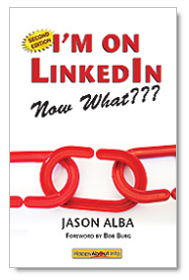
Steve Tylock wrote his book, The LinkedIn Personal Trainer, the same time I was writing I’m on LinkedIn — Now What??? He actually beat me to press, though… so I can’t claim the fame of having the first LinkedIn book (darnit!) :)

Anyway, he’s a very nice, savvy guy, and he has EXCELLENT thoughts on the groups stuff.  Here are two posts he wrote about LinkedIn Groups:

Group Search Available On LinkedIn - he says “It’s not perfect, but it’s a whole lot better than what you could find out yesterday” …

What We Didn’t Know About Groups… - probably the biggest issue the new LinkedIn Groups search function exposes is the number of like-groups … that is, the number of groups dedicated to a single cause or group, exist.  In Steve Tylock’s example, he says there are four alumni groups for “SUNY Buffalo”… doh!  Which one is school-sanctioned?  Which one should I join?  Which ones should I NOT join???

This can be (will be) a big issue.  Now, interestingly, my JibberJobber Career Management LinkedIn Group has almost 1,000 members (I think it’s around 800 right now).  If someone started another JibberJobber group, I don’t think I’d have a problem with that, as I’d love to have a fan create a group and promote it… how cool would that be?

Whoa… but what if someone who is a competitor, or a leech who just wants to benefit from a brand I’ve created comes along… then I have a typical branding issue.

This is exactly what has been exposed with the Groups searching ability on LinkedIn… interesting problem, eh?

Unfortunately, it’s not the only problem that has come to light because of the searching ability on LinkedIn Groups.  The comments about LinkedIn Group searching has created a storm over on the My Virtual Power Forum (used to be My LinkedIn Power Forum), which have really been an interesting read.

More on that later.

Searching for LinkedIn Groups? Now you can… finally!

July 9th, 2008

I got an e-mail from LinkedIn yesterday, as a group owner, that they are building a search feature into the LinkedIn Groups page by the end of this week.

It’s about time :p Whenever I talk about LinkedIn Groups, one of the most common questions is “how do I find LinkedIn Groups I should join?”

I’ve even blogged about finding LinkedIn Groups before, and tried to piece together some sources for you… but maybe that will all be useless and outdated once July 11th comes around.

There’s a bunch of information on yesterday’s blog post at the LinkedIn blog about this feature… the thing I found most interesting is they say there are over 90,000 LinkedIn Groups.

Man, that’s a lot more than I would have guessed!  After they release the search feature we’ll be able to see which Groups we should join :)